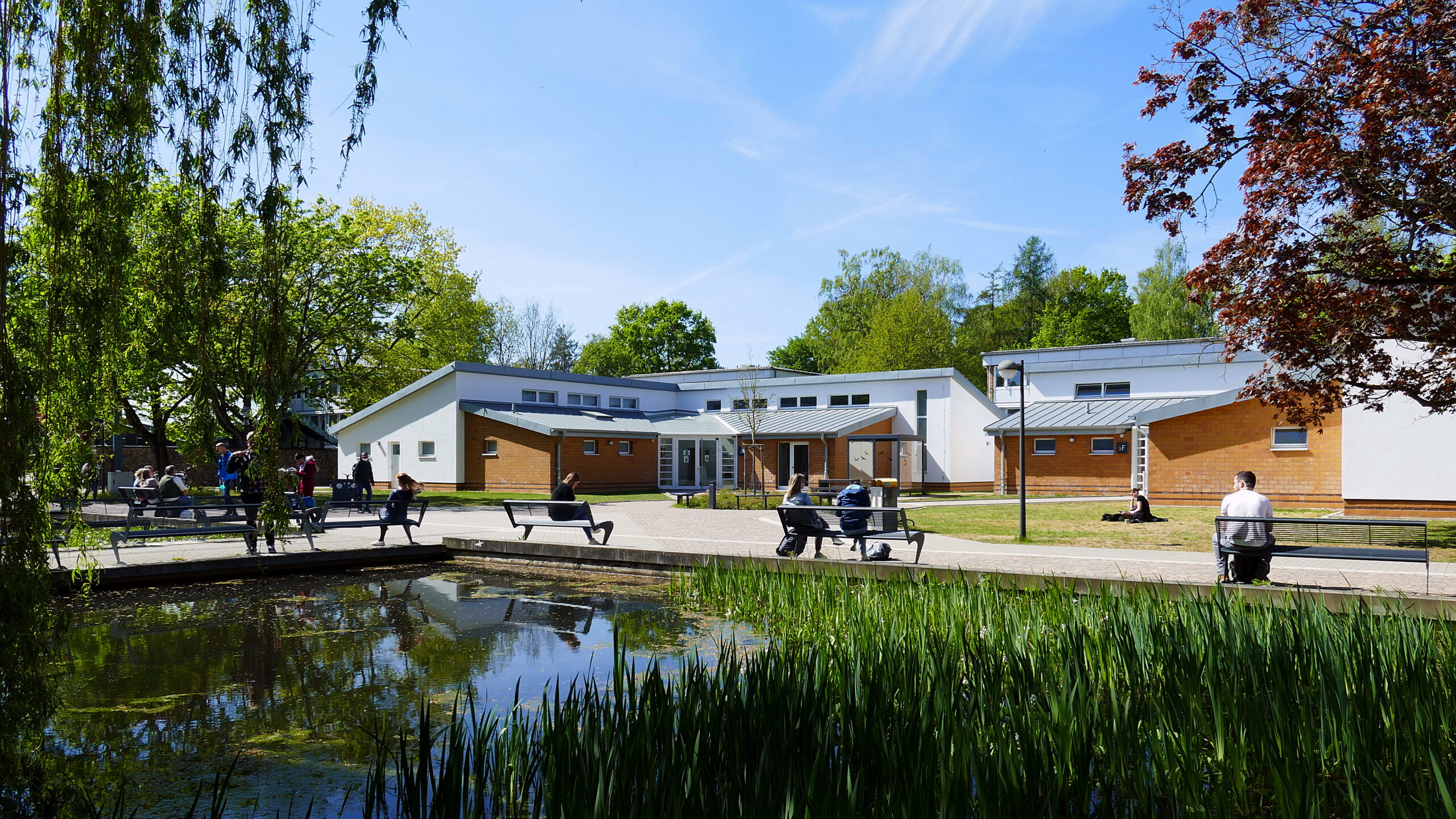
Hochschule Hannover – University of Applied Sciences and Arts, with around 8,500 students and five campuses, is the second-largest higher education institution in Lower Saxony’s state capital. It offers a broad range of study programmes in the fields of engineering and business, social sciences, as well as information technology, communication, and design. In addition to teaching and research, the university serves as a source of innovation and a transfer partner for business and society at the city, regional, and state levels.
A central location for the humanities, cultural studies, and social sciences is Faculty V – Diakonie, Health and Social Work at Campus Kleefeld. It emerged from the Protestant University of Applied Sciences Hannover, which was integrated into the university on 1 September 2007, and has its roots in the deacon training programme of the Stephansstift as well as in the Christian Social Women’s School founded in 1905. The faculty offers degree programmes such as Social Work, Special Needs Education, Religious Education, Nursing, and Health Sciences. Research at Faculty V is concentrated in the Institute for Applied Research in Health, Education and Social Sciences (GBS), which investigates social participation, health equity, and the development of professional practice, and acts as an interface between academia, institutions, policymakers, and civil society.
Faculty III – Media, Information and Design also makes an important contribution to research in the humanities and cultural studies. It offers degree programmes such as Journalism, Public Relations, Visual Communication, and Visual Journalism and Documentary Photography. Its research spectrum ranges from empirical data generation to theoretical work in the humanities and cultural studies, as well as visualisation strategies and artistic research. An example of interdisciplinary collaboration across faculties is the project "ErPA," in which Faculty III and Faculty V work together with Bielefeld University to analyse personal accounts of care recipients and their relatives on social media, with the aim of improving the quality of residential elder care.